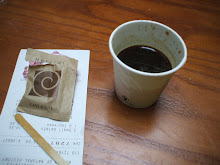
So my week, which was already unnecessarily busy, has been further hijacked by a fever. Poor Banana woke me this morning to say her head hurt. When I touched her hand, it was hot and shaking. A quick temperature check later confirmed that she wouldn't be going to school today, and that the rest of my week was suddenly a question mark.
The bright spot? The very sweet moment when she told me I could have the last two pieces of the apple I gave her to eat while she watched TV. (Now, if I could only translate that sweet sharing to the moments when she is playing other kids, we'd be fine.)
Wednesday, February 20, 2008
awesome visions of the City of the future

This is just classic. The brilliant worlds possible with technology as we envisioned it decades ago are remarkable to look at now. Especially when you realize how far we haven't come.
(via Gothamist)


Friday, February 15, 2008
Friday fun - another 80s edition
So, yeah, light posting this week. That's the kind of week it has been. Maybe later, after a few pints and some adult time away from kids, maybe then I'll have something worth writing about. In the meantime, Banana was demonstrating some ballet moves earlier in the week, and I swear at least one of them must have been from this video...
Monday, February 11, 2008
design and ad fun
As part of a project I've been working on at home, I've been poring through several turn-of-the-century copies I have of North American Review, Harpers, and the Atlantic Monthly. There are some real gems of classic type and art, not to mention a certain degree of hilarity.


Verizon sucks, pt. 7,001
I shouldn't have to write this post, particularly after the last round we had to go through on this saga. But I do. Because I got another letter from a different collections agency seeking to collect the $505.91 bill that was supposed to have been wiped out in the summer, and then again in October. But somewhere down in the system it wasn't.
This means that I have been trying to get this mess cleared up since July. And that's just the billing portion.
This kind of inattentive idiocy is simply unconscionable and unbelievable. Even the CSRs who have actually tried to help me navigate some of this mess have been befuddled by the complications that seemed to start with a poorly recorded move order and a subsequent call to clear up the billing foul-ups related to that order. Every fucking part of this saga stems from those two phone calls and the inability of those two CSRs to record correct changes.
To wit, and to repeat... for the hell of it:
Words don't cover the absurdity of this. The pity is that I very much like my service, but the inability of the various levels at Verizon to deal effectively with a clear and documented screw-up on their part is patently absurd.
Anybody know how to get up the chain with Verizon FiOS corporate to resolve this?
Oy.
This means that I have been trying to get this mess cleared up since July. And that's just the billing portion.
This kind of inattentive idiocy is simply unconscionable and unbelievable. Even the CSRs who have actually tried to help me navigate some of this mess have been befuddled by the complications that seemed to start with a poorly recorded move order and a subsequent call to clear up the billing foul-ups related to that order. Every fucking part of this saga stems from those two phone calls and the inability of those two CSRs to record correct changes.
To wit, and to repeat... for the hell of it:
- I placed the initial order to move my service from my old house to my new house the week before Memorial Day. When I had, in fact, moved and called to find out why the tech hadn't come out to make the switch on the day I had taken off work, I was told that there was no record of the change order. To their credit, they had a tech out on that Saturday to do the install. That tech decided not to install a new router or set-top box because I already had the right ones. Fast forward six weeks...
- I receive a bill for service at both my old house and my current house. The bill also includes charges for the equipment. I get on the phone the next day with the business office to clear up the issues. The CSR is very nice and assures me she understands the situation. She understands it so well that she turns off the service at both locations. Madness ensues as I get on the line with CSR after CSR to resolve the situation. This process takes nearly two weeks.
- As part of the resolution, I am guaranteed that all of the outstanding bills—including any outstanding bills from before the move—will be closed. I am also given a month's free service. Yet here we are seven months later and the situation is still dogging me.
Words don't cover the absurdity of this. The pity is that I very much like my service, but the inability of the various levels at Verizon to deal effectively with a clear and documented screw-up on their part is patently absurd.
Anybody know how to get up the chain with Verizon FiOS corporate to resolve this?
Oy.
Friday, February 08, 2008
carbonara
Carbonara truly is a dish that reminds you how good life can be. With approximately six ingredients and the perfect balance of savory and cheesy, and peas to add a bit of sweetness and texture, it is simplicity in form and purpose. Like life, it also takes a few tries to learn how to make well.
As a disclaimer: it is also the antithesis of vegan dishes. Sorry to my vegan friends.
That's all for now.
As a disclaimer: it is also the antithesis of vegan dishes. Sorry to my vegan friends.
That's all for now.
friday fun
Further proof from the Electric Company that my generation was raised on entertainment made by people who were very, very stoned...
Wednesday, February 06, 2008
conversations
I was chatting with a friend of mine earlier this evening about the directions life takes us. He asked, "So do you see yourself leaving Richmond?"
"No," I answered. "Not for the time-being. Too much has happened over the past few years, and I'd hate to do that to Banana or myself. Besides, we've got a pretty good life building here." It's the truth. We do have a good network of friends and family in Richmond now, and there has been too much upheaval in recent years. For all of my running and moving over the years, it's nice to cool my heels and make an effort at calling some place home.
"Yeah," John said. "I can see how it would be awfully difficult to move some place like New York or Boston as a single dad with a school-age child and everything else you've got going on. It would be pretty daunting."
But that's where I disagreed with him. I said, "After everything that I've been through in the past few years, nothing seems that difficult." This was true, too. From the emotional ups and downs since 2004 and after the shooting, nothing seems impossible. You just survive and muddle through, and find the best, most positive way of adjusting to the transience of life. Then you figure out what the problems are and solve them as best you can.
It's all risk and reward, and the best you can hope for is that you made a good decision.
random musings for Wednesday

I could write long posts on any of these, except I can't because my spare time seems to have evaporated along with winter...
- I am completely psyched that Trader Joe's (!) and Whole Foods have finally decided to crack the Richmond market (pun fully intended). I am disappointed, however, that neither company chose to reuse an existing structure, thereby reducing the amount of unnecessary building and traffic-inducing sprawl.
- Stress is general all across the land. No one I know ever seems to have enough time for all the things that need to get done. And no matter how efficient you try to be, there is always the chance that something will throw off the daily rhythm. And increase the stress.
- The developing Democratic primary race is fascinating. No matter what happens, this will be an historic election. And no matter what happens I don't think Nuts McCain will win.
- I have never been a pro football fan in my life, but I still found myself cheering out loud during the last two minutes of the Super Bowl.
- It is forecast to hit 80 degrees in Richmond today. In February.
- I have lived with one variety of pain or another for 317 days. But when life gets me (or you) down, think of sun and water.
Back to ticking things off my to-do lists.
Monday, February 04, 2008
super bowl ads
First: Go New York!
Second: These are the ads that rose to the surface (or at least stuck with me) through this year's crop of ads—a crop that seemed to be heavily tilted toward movie references...
Second: These are the ads that rose to the surface (or at least stuck with me) through this year's crop of ads—a crop that seemed to be heavily tilted toward movie references...
- Audi R8 — Beyond the fact that the car is outrageously cool, the rich man waking up with the decapitated grill of his Rolls next to him was a brilliant homage.
- Budweiser, the Rocky ad — As cheesy as this one was, it made me and everyone else in the room laugh.
- Bud Light with Will Ferrell — I will have to find this one on YouTube. Sentences don't do it justice.
- CareerBuilder.com — The heart jumps out of her body and trots into the boss's office to quit. A little silly, but effective nonetheless.
Sunday, February 03, 2008
PTSD updates
The odd thing about the psychological after-effects of the shooting is that they seem to have very little to do with actual physical discomfort. They also rarely come with the shocking realization that I was shot or that I was one inch from death. Now, the impact is subtler.
It comes at moments as happened this weekend when I realized that I was taking my first real hike with Reilly since just before the shooting. Or over the past couple of weeks when I realized that the last creative project I did went to press the week before the shooting. What comes from these parallel realizations is the recognition of how stuck I have been in the past ten months.
And it's not even in big ways such as these. No. It's in small moments when I stall out, when I don't know what I'm supposed to do next or why. This is beyond flashbacks. It's deeper, subtler, and in some ways scarier.
There are also the moments--and these are often lately--that I find myself touching the entry and/or exit scars. The action is absent-minded, but it is a reflection of the fact that I never--for a single minute of any day--forget that I was shot. It never goes away, dammit.
Friday, February 01, 2008
friday Fun - ad hilarity
As Steve Hall at AdRants describes it, this spot
Find more videos like this on AdGabber
leaves behind last year's Maposaurus for this year's Napoleon who, after racing through the streets of France (anachronistically in a car?), arrives to command his troops but has to hide that nifty yet-to-be invented Garmin navigational device, hence the explanation for his famed placement of his hand inside his coat. Witty enough. Catchy tunes. Just not sure we get that whole time shift/travel thing.
Find more videos like this on AdGabber
Wednesday, January 30, 2008
Bye, Rudy
Cue the Green Day. America's Mayor (insert choking sputter here) has shut down his moribund campaign. And judging from his tone in the concession, he was happier getting out than he ever was when he was (insert 9/11 reference here) in the race.
Tuesday, January 29, 2008
so true

Okay, so I want to be hip enough to hate the lolcats phenom, but sometimes you just need a stupid chuckle. And then sometimes, you come across a really true one.
That was Banana from two to three. Now I don't make it past more than two pages in the Secret Garden every evening before she is completely out.
retribution?
I understand, as much as anyone, the urge to get back at an ex, maybe even the occasional mean-spirited thought about how to do it. But this strikes me as a little over the top:
Anne Marie, 48, from Grand Rapids, Michigan offered www.craigslist.org users the chance to kill Carol, a 56-year-old woman in California, in a vaguely worded free ad under the category of "Freelance," according to court documents.
Monday, January 28, 2008
Thoughts upon rereading Unbearable Lightness of Being
This is perhaps the sixth or seventh time I’ve read Unbearable Lightness, and each time new things rise to the surface of the book. This reading was different, however, because I’m older, a parent, and a have a failed marriage behind me.
In the past I’d always looked upon Sabina as the intriguing force behind the book. She is, after all, the beautiful and mystifying artist, and she draws men to her particularly because she is light and “free.” On a side note, the fact that Lena Olin played her in the film helps craft this attraction.
On this reading, however, Tereza rose to fore. Because of her weight, she becomes the more complex character. She rides her own quandaries through her ill-fated attempt to have an affair and through her fears and anxieties, and she begins to validate her own self-blame by the end. Until she realizes what Tomas realized when he had an epiphany about her trembling hands and until they begin to communicate. In fact, it is remarkably touching when Tomas finally opens up to her in the closing pages about his son and about his love for her. At that point, it is clear that the journey they’ve made through the book has changed them both, and finally brings us into that beautiful moment of happiness when a night-time butterfly flutters out of a light as the strains of music rise from the cafe.
Tomas is still a cad, of course. But he is a complex cad. In fact, his refrain from Beethoven of Es muss sein! ends up as both a rationalization for his philandering and for his change. As a misguided rationalization for pursuing all women, it grows from that supposed need to understand the millionth part; as a reason for change, it is part of his acceptance that his life with Tereza must be—and must be just with Tereza.
I have admired Kundera over the years for the ways in which he orchestrates his work, but I see even more clearly how the closing pages here finally pull all of the small and large ideas he has laid out together.
consumer protection?
Oh, this is just brilliant. The White House is vetting candidates to run the Consumer Product Safety Commission, and the Wash Post leads the article with this:
Sounds innocuous enough (sort of?) until you get down to this:
We want more government by of and for business, dammit! Screw the consumers!
Oy.
The White House is considering a scientist who has frequently testified and written on behalf of the energy, pesticide and tobacco industries to chair the nation's chief product-safety regulator.
Sounds innocuous enough (sort of?) until you get down to this:
"She's not thought of as a consumer advocate per se but as someone hired by industry to represent their point of view," said Lynn Goldman, a former assistant administrator for the Environmental Protection Agency under President Bill Clinton, who has testified at hearings with Charnley.
We want more government by of and for business, dammit! Screw the consumers!
Oy.
Sunday, January 27, 2008
I need a real digital camera...

I spent some time this afternoon taking shots of a number of print and art pieces. After working out the light questions, I was fairly confident that my little Fuji A700 could handle it. I was wrong. More than half of the shots look like I used a spherize effect in Photoshop.
pool days
For fun, though, and for the potential nostalgia of friends from those years, here's the inventory of places I remember:
- Toad Hall — This is where it all started when I moved to the city. A great bar with a great set of regulars, and one of the most competitive pool crowds anywhere.
- Construction Zone (closed) — A hellish bar, but I'd end up there either before or after a stint at Toad. Most of the bars like it went away with the encroachment of mini boutiques on West Broadway.
- Bleecker Street Bar — Fights over pool. Fights over darts. And an infamous pool team run by the man who almost bankrolled my magazine project.
- Barrow Street Tavern — A weird bar with two bad tables downstairs. The felt was in bad shape, and the angles forced the regular use of short cues. Still, it was around the corner from my first apartment in the city, and that counted for a lot.
- The Stoned Crow — Betty probably still presides over the pool table. I had many, many long nights of running the table with Greg, Seth, GB, and many others. Proximity was also a great value here.
- Bull's Head Tavern — The last bar that hosted one of my teams. I still regret not asking out the little blonde named Sabina who worked there... maybe not, but she was cute and flirted with me to no end.
- Raccoon Lodge — Uptown and down, but mostly down. They'd cut your tie off if you didn't take it off.
- Brooklyn Inn — Simply the best bar anywhere. At least it was then, and friends say it still is.
- Corner Billiards (closed) — It's turned into Amsterdam downtown. No idea if that's an improvement or not.
- Fat Cat Billiards — A dingy little hole off Christopher Street, but they were generous about time and prices. It's also the first place I learned to play straight pool.
- Julian's (closed) — The saddest story in the world. They used to have Bud in the Pepsi machine, and you could play all night long for a pittance. It was like walking out of The Hustler. Now, it's an NYU dorm.
- Chelsea Billiards (closed) — For a while, this was the best pool room in the city.
- 119 — This little dive beneath Irving Plaza became my regular post-work hangout when I was working around Union Square. It was also the scene of my going-away party before I left the city. Many, many good memories... except that I hated the red felt on the pool table.
- No Idea — And I have no idea why I remember this joint but not others.
- The Edge — Who could forget the bar just down the street from the Hell's Angels house?
- The Blue and Gold (closed) — One of the dying breed of East Village Eastern European dive bars.
- ArtBar — I remember the name, but not the place.
- Bar None — Same here.
- Frank's — I think I have the name wrong, but I spent a good many evenings at this joint down near the end of Court Street. It had great beer, two decent pool tables, and a crowd of low-key players.
- The Alibi — Pioneering bar in Fort Greene. No idea if it's still there.
- The Ace Bar — A hangout before you were supposed to go past Avenue A.
Saturday, January 26, 2008
saturday nights
In New York and then in grad school, you'd rarely find me at home on any given evening, and particularly not on the weekends. The only exceptions to this rule were nights when I hosted friends for dinner or when I was so fried from work or life that I needed downtime. Otherwise, I was out.
Starting in 1994, this meant playing pool. I kicked around bars and pool halls from New York to Fayetteville and beyond. I drank a lot. I had loose-knit groups of friends, many of whom I have lost (for better or for worse) to those smoke-filled nights. I smoked my Gauloises--first the caporals made from the stinky black tobacco, and then after they gave me a cough I couldn't shake, the legeres. There were even a few periods when I was so tight on cash that I slipped back to the old Tom Waits character-standard, Old Golds. And always it was back to the bar or the pool hall Sometimes I'd play for money; sometimes I'd play for table time; sometimes for drinks; mostly my friends and I would play to hold a table until someone could unseat us. There were many late nights and early mornings, and in the years I worked second shift in the graphics department at J.P. Morgan, getting off at midnight with a decent chunk of cash in the bank, I saw more early morning meals at downtown diners than your average college student. In that life, you learned to spot cokeheads quickly and hustlers too, and made enough mistakes to say you should've known better. For the first couple of years of grad school in Fayetteville, things were much the same--late nights of too many cigarettes and too much beer and whiskey, and nine-ball games that continued after the bars had closed. The venues were smaller, and there were fewer of them so new challenges got stale quickly. And of course, any pool crowd has a certain percentage of characters straight out of central casting. The only difference was that I made a little more time for my curricular responsibilities, and punctuated the pool nights with nights out with the other writers--some of which had their own ill-fated results. And through all of it, I rarely knew what it was like to spend a whole evening at home.
Fast forward a few years. Slip past a whole panoply of life's roller coasters. And you land here--a Saturday night with a little girl asleep in her pink room, the iTunes on party shuffle, a couple of Yuenglings to take the edge off a long day. It's a good thing, too, because I needed to slow down and catch up with my own life. (There's also a physiological component since my shoulder and back issues necessarily mean I can't spend much time over a pool table.) The things that had been in boxes for years are beginning to feel organized; my portfolio is getting some much-needed attention; the laundry and dishes are regularly clean and put away; goals and hopes and expectations are beginning to make sense rather than appear as products (or victims) of inertia.
Do I miss those days? Those days before I had these constraints and responsibilities? No. Not really. I like being a dad. I like being at home. This life feels richer, more full of potential. And besides I know where to find a pool table when I have the time to play, after I've taken care of everything and everyone else.
S. Carolina Obamarama
Good on Obama for his big win. Good on the Democrats for turning out a record primary turnout. I just wish I could be happy about the results.
I suppose I should offer a quick disclaimer that none of the candidates really excite me. That said, I also have a distinct uneasiness about Obama and his cult of personality. He is remarkably intelligent and carries a shocking charisma, but he is young and lacks a depth of national experience I feel a president needs. I worry that he won't command enough respect on the international stage—a concern that should be central to this election cycle. After all, whoever is elected will have a lot of fence-mending and relationship rebuilding to do.
Back to the personality question, though... I must admit that I am inspired by his speaking, but then I look past the impassioned rhetoric. What I find feels a little too much like a lot of pretty words without the kind of policy depth and substance I want from the person who is going to undo the mistakes of the past eight years.
Ultimately, I guess that's what I'm most looking for in a candidate. We are in a horrendous morass in Afghanistan (remember that one?) and Iraq. Our international standing is in a shambles. Our economy is teetering on the brink of recession, or worse. Our social structures from education to health care and beyond are a mess. The downside of government by and for the corporations is finally beginning to show from quality of consumer goods to danger to our food chains. The next president must be able to take the reins with respect and the right team from day one. I worry that Obama may not be the answer.
Friday, January 25, 2008
friday fun - the design geek edition
Yeah, I'm a design geek. Yeah, I am. Probably even more than I am a writing geek.
Friday Fun - the NSFW edition
If you are faint of heart or easily offended, do not watch this video. If you are an amoral relativist lover of all the glory that was King Missile, revel in the memories...
Don't say you weren't warned.
Don't say you weren't warned.
Thursday, January 24, 2008
organizing
Light posting this week, too. I'm on a major reorganization kick at home and at the office.
Tuesday, January 22, 2008
bye, Fred
Too bad your made-for-TV campaign wasn't... We'll miss you. Really. You almost out-Eeyored Joe Lieberman.
Sunday, January 20, 2008
random notes
As an occasional writer, I've developed a well-honed habit of recording random things on whatever scrap of paper is handy--ATM receipts, napkins, anything really. Whenever I go through one of my cleaning cycles, I stumble across some of these random notes. Going through my drawers, I just found a napkin with quotes from a conversation with my friend Carter sometime in the past year. The notes are
- "That puts my fucking dada-ist coffee table book to shame."
- "I am fucking so Studio 54."
- "Charlie Brown is Job."
- and last but not least, "I work for people who dress their children in burlap."
Friday, January 18, 2008
sexy computer advertising

Really. This is what used to pass for computer ads. Hell, this entire collection of old computer ads via AdRants is just a brilliant window back to the days when a 300 meg hard drive could run upwards of $20K, and Bill Gates loved Radio Shack computers. God, how many people remember the Trash-80?
bread crumbs, er slices
Find more videos like this on AdGabber
Brilliant work. I love the play between the final storyboarded lines. The tension is established, and then the suggestion plays directly to a random fact that pulls the whole thing together. As one of my old CDs told me once, a good ad tells a story.
(picked up from AdRants)
Thursday, January 17, 2008
dry needling
So, the details of dry needling are:
There is a certain amount of masochism involved here. After the treatments, my muscles ache and my left hip—the spot that seems to have taken the most problems after the shoulder—is stiff and painful. Still, I have more motion, and it's easy to see how these treatments may actually break through the final stages of my pain. As a collateral benefit, it's also easy to see how I may end up in better shape than I was before the shooting, or at least in the position to get into better shape.
For the moment, however, I am apparently going to have to go through pain to get rid of pain. If only I didn't hate pain meds...
- The physical therapist identifies the points in my muscles that are causing the greatest tension and pain.
- She takes a needle very similar to an acupuncture needle and puts it into my muscle at the trigger point.
- I squeeze the pain ball and try not to move.
- She works out tension on related muscles while I discover the exact meaning of referred pain.
- Repeat seven or eight times depending on the treatment, then ice the affected areas.
There is a certain amount of masochism involved here. After the treatments, my muscles ache and my left hip—the spot that seems to have taken the most problems after the shoulder—is stiff and painful. Still, I have more motion, and it's easy to see how these treatments may actually break through the final stages of my pain. As a collateral benefit, it's also easy to see how I may end up in better shape than I was before the shooting, or at least in the position to get into better shape.
For the moment, however, I am apparently going to have to go through pain to get rid of pain. If only I didn't hate pain meds...
Monday, January 14, 2008
Christmas randomness

It was good, this Christmas. Very good. Bittersweet, too, but that's life, right?
New stuff at the Flickr gallery.
Risks
Life is all about risks, isn't it. Whether it's because I'm a Scorpio or because I was raised in a risk-averse environment, I've never been very good at risks. I've never been very good at gambling--too afraid of losing--or taking chances in life--what if I'm wrong? And yet, at the same time, I've taken huge risks for random reasons. I guess one of the more interesting lessons in this little soul journey I've been on for the past few years is learning how to take risks--how to be confident enough to risk losing in order to make strides forward in life. And like so many of these lessons, this one is broadly applicable to so many aspects of this little thing called taking control of my own life.
Monday midday fun
Since I'm still not in the mood to write, and since people around me keep coming up with random distractions... Hilarious!
Later.
No Pants Subway Ride
Hundreds of people. In underwear. During a Friday commute. Brilliant!
I miss New York.

I miss New York.
Sunday, January 13, 2008
sunday night fun
Regular posting will resume soon, but in the meantime, I thought of this last night. If only I had the time (and money) to do some really fun spec stuff like this...
Friday, January 11, 2008
friday fun – the 80s edition
At physical therapy today, I had the pleasure of hearing in succession: "Oh Cherie," "Come Dancing" and "Wishing Well." And now for your nostalgic pleasure...
Tuesday, January 08, 2008
life-hacking lessons — the purger vs. the pack-rat
I've veered between these two poles over the years. There have been times where I have accumulated things like scotch tape attracts dog hair. Those periods are often followed by a move or some other reason to purge myself of things that seem unnecessary to my life as it is at that moment—and as I envision it in the future.
Unfortunately, if you are not judicious about your purging, there will come a moment when you realize that you cannot find—and may never be able to find—some things that you very much wish you had kept.
Unfortunately, if you are not judicious about your purging, there will come a moment when you realize that you cannot find—and may never be able to find—some things that you very much wish you had kept.
Life with Banana
So, this morning, we both woke up late, and I had to ride herd on Banana to get ready for school. We also have a bit of a crisis because her ballet shoes have gone missing. They're easily replaceable, but my bank account is still in the post-Christmas hangover. Anyway, I asked her to help find them; she trotted off dutifully. Until about ten minutes later. That's when I found her wearing a Santa hat and reading a book about frogs we were taking back to the library. As she walked around "looking" for her shoes Part of me wanted to get mad because we were on the verge of being late, but I had to laugh anyway: Hanna Andersson twirl dress, pink boots, Santa hat, frog book. That's my little girl.
And we still made it to school on time. Even if the ballet shoes are still MIA.
And we still made it to school on time. Even if the ballet shoes are still MIA.
Sunday, January 06, 2008
Topsy, the beginning - the final edition of recycling old writing
Here is the final installment in the essay. Click here to read part 1 or here to read part 2.
The day of the execution was blustery and cold. Though some later reports claimed a huge crowd, by early afternoon—the execution was scheduled for noon—the yard was sparsely filled by reporters and some local luminaries. Construction workers and police officers were stationed near the walls of the park to function as security for the huge crowds expected to attend. In the end, their job turned into half-hearted attempts to stop boys from sneaking through, under, and over the walls to catch a glimpse of the execution. A little before two, the word was given and Edison started his camera rolling.
Skip Dundy, Carl Goliath, and two other men led Topsy out of the stable into the yard. She followed obediently—Goliath had been working the past week to get her to trust him; elephants’ relationships with their handlers are so important. They crossed the yard in front of the small crowd, mostly men in dark suits, coats, and hats, and boys peeking out around corners. Twice Topsy paused as though she knew she were heading out for a show and wondered where Whitey was, or what she was expected to do. With each step, the anticipation grew, and a mix of fear and excitement crossed Skip Dundy’s face. Finally, they reached the walkway, a narrow, reinforced plank leading up to what had been the scaffold. Instead of a noose, though, they had rigged up two large conducting plates, one each for a front and back foot.
Topsy balked. Dundy stood on the plank above her and Goliath stood next to her and tried to coax her onto the plank, but she froze at the bottom of the walkway and would not be moved. Try as they might, the elephant would not budge. The men tried for a few more minutes to coax her onto the walkway, until Goliath said there was simply no way she was going up there without Whitey. Though Thompson was exasperated and in danger of being embarrassed, Dundy convinced him to offer a Whitey a chance to come back to them. They would offer him twenty-five dollars and forgiveness for all he had done if he would help bring Topsy onto the scaffold. The men who had let him into the stables, and who were as close to friends as Whitey had, were sent for him. Once they had woken him up, they convinced him to come with them back to the park. Whitey refused, and when they tried again, he slammed the door in their face. Unsuccessful, they returned and were immediately sent back with a new offer: fifty dollars, a new job, and forgiveness for his transgressions. Whitey put his cap on and followed them, but when he saw the scaffold and the wires, he too froze and refused to help. Realizing what was really going to happen, Whitey slipped away and disappeared. (A picture was taken of him before he left the execution and in it he looks like a perfectly normal, but very sad man in his thirties. That was the last anyone at Luna Park saw of him.)
This left them with a problem.
Finally, Edison consulted with Thompson and, P.J. Sharkey, the chief electrician at the generating plant, and they came up with an alternative: set up makeshift electrodes on the ground where Topsy stood. At this point, though, time was ticking away and Thompson knew his audience would be getting restless; they had to work fast. Furthermore, Topsy’s chains were being held by four husky workmen, as though they could stop her if she became unruly.
As the electricians worked to set up the new electrodes near the elephant, a veterinarian hired to be present for the execution fed her carrots laced with 460 milligrams of potassium cyanide. While he knew this dosage wouldn’t kill her, he certainly expected her to be more subdued by it than she was. Instead she happily snacked on the carrots and looked for more when she was done. Meanwhile, the electricians extended their wires and moved the electrodes from the scaffold.
What they had created were metal plates cut to the shape of an elephant’s foot. Each was bolted to a wooden board and the main wires were attached to the plates. One would be placed under her right front foot and the other under her left rear foot—it was assumed that the best way to electrocute an elephant would be diagonally through the body. These electrodes were to be strapped to her feet so that she couldn’t easily lift them as the current was going through her body and she would be chained too. Finally, they had no idea what sort of voltage would be required to execute an elephant as large as Topsy; Edison had experimented on many animals, but none of them as powerful or large as this; they decided to set the number quite high: six thousand volts of direct current.
With the help of Dundy and the other two men, Goliath carefully coaxed Topsy to lift her feet, first the front, and then the rear so that the electrodes could be slipped underneath. Perhaps mellowed by the cyanide, Topsy complied easily, but the boards splintered and fell apart under her weight. Once the electricians had made certain that the electrodes would work and were still in contact with her feet, Dundy—it had to be him, of course—secured the final rope to the harness around her head. The four of them left Topsy alone in the middle of the barren construction area.
Edison now restarted the camera which he had stopped when she first balked. The frame was centered on Topsy to catch everything that happened through the course of the actual execution.
The current was switched on and Topsy turned her head to see what the commotion was about. The electricity was shooting through her, though and she pulled at her rear foot where a puff of smoke had first appeared. Less than a breath later, she tried to pick her front foot off the plate. That was when the current really kicked in, though, and a large puff of smoke and some flame exploded from the front foot and then again the back. Her body went stiff and shook involuntarily for a few seconds and the volts continued to shoot through her. She fell with her free hind leg stuck out, her body prostrate, and as she fell, the ropes tied to her harness pulled the stakes out of the ground.
The execution took twenty-two seconds. The veterinarian pronounced her dead at 2:48 and the partners and Edison congratulated each other, exchanged hand shakes.
A Brooklyn Daily Eagle photographer took two photos that ended up in the paper the next day. The first was of Topsy falling, and the second was of Thompson, Dundy, and thirty of the more important spectators standing in a half circle around the carcass. These photos and the notoriety of Edison’s electrocution of the killer elephant gave Thompson all the extra publicity he was looking for, making the future Luna Park stand apart from George C. Tilyou’s Steeplechase as much as giving it a legend for years to come.
After Topsy was pronounced dead and the photos were taken, the other dirty work started. In what remained of the afternoon, her body was dismantled—Hubert H. Vogelsang had bought the remains in advance. The organs were sent to the Department of Biology at Princeton for further study. Her skeleton was kept by Vogelsang for undisclosed purposes, and the head was later mounted. Finally, two of her feet, the ones not burned by the electrodes, and a portion of her hide were preserved for Thompson and Dundy. They made umbrella stands of the feet and a chair of the hide.
****
There is no record of where these items finally ended up. In fact the only firsthand record of the execution is that film of Edison’s. The only way to know, other than by far-removed explanations, that this film is accurate is that the images in it match closely the pictures shown in the Brooklyn Daily Eagle, from January 5th, 1903. Beyond inconsistent newspaper accounts of the execution and Edison’s short, silent, uncatalogued film, however, accurate information is impossible find.
Like so many accounts of old Coney Island, the stories about Topsy’s execution change with the teller. Depending on who tells it, for instance, the year may change, the reasons may change, the fate of her remains may change. One account even put Topsy’s death in the thirties and claimed that Thompson and Dundy had executed Jumbo, P.T. Barnum’s elephant, in the early years. But the story in all its variations stays with the place; in the annual Mermaid Parade, a group still reenacts the execution.
After Luna Park was sold by Thompson following the death of Dundy a few years later, it went bankrupt twice and was finally destroyed by two fires in the nineteen-forties, long after the glory of its original attractions had passed. Steeplechase Park, legendary for rides and ribald stories, finally closed in the sixties. In fact, of old Coney Island, all that remains is the rickety joyride of the Cyclone, the Wonder Wheel, Nathan’s hot dogs and a housing project named for Luna Park.
The rest is fantasy based on dying memories and pictures. All the dreams Coney Island created never could save it from the outside world, electrical fires, or the inaccurate eye of history.
Friday, January 04, 2008
iow-ow
I must say that the strength of Obama's showing surprises me more than the fact that he won. Still, I think the Democratic race is going to remain a crapshoot for some time--despite the prognosticators who think Edwards and Clinton should be worried. I do agree with writers on Daily Kos and elsewhere who have picked up on the strength of the youth showing; it's a trend we need to encourage.
What blows my mind, however, is the Huckster. Not that I care for any of the Republicans—in fact, I think it is one of the worst fields I've seen in my adult life—but he is such a buffoon. I do agree with Brian, however, that Huckabee's candidacy brings about the delicious possibility of a schism in the fraying Republican fabric.
What blows my mind, however, is the Huckster. Not that I care for any of the Republicans—in fact, I think it is one of the worst fields I've seen in my adult life—but he is such a buffoon. I do agree with Brian, however, that Huckabee's candidacy brings about the delicious possibility of a schism in the fraying Republican fabric.
Thursday, January 03, 2008
Topsy, the beginning - another edition of recycling old writing
The next section of the essay...
The day after Christmas, Whitey started drinking early again. After making his way around the Bowery, and finally slipping a flask in his pocket, and drinking himself to the point where distances didn’t make sense, he saw one of the Italians make a gesture he was sure was an insult. Topsy didn’t deserve to be hauling wood for these wops.
“Sic ‘em,” he told Topsy in the language he had developed to train her.
Topsy obliged. She dropped her load and tore after the group of workers, trumpeting and sending debris in all directions as she went. Terrified of this behemoth bearing down on them, they did the only thing sensible: they climbed the scaffolding.
Whitey yelled at her to keep on going and Topsy stood on her hind legs. She roared and started to push at the structure with her front legs. After a minute, she stood on all fours, lumbered around to another side, and continued her assault. Thompson and Dundy came to the door of their office which opened out on the central part of the park, and several workers and Carl Goliath came running out to see what the ruckus was. Dundy called on Whitey to call her off, but Whitey ignored the command. Several of the men were summoned to get Whitey to cooperate and Carl Goliath went to the yard to try to get Topsy’s attention.
She ignored him and continued as Whitey egged her on, in spite of the larger men who were now holding him and telling him he had to make her stop. When their entreaties didn’t work, they resorted to beating Whitey until he was lying bruised and bloodied on the ground. Finally, he stood up and called her off with a simple whistle. Carl Goliath, who had been working as an elephant keeper for a number of years at Hackenbeck’s and could handle most animals, had never seen another handler with such control over his elephant. He helped harness her up again and walked behind Whitey as he limped her back to her stable.
Already word was spreading around the streets that the killer elephant had gone on a rampage again. Thompson and Dundy both knew that they could not afford this kind of publicity. The question was how they could turn the event—and their six-ton problem—into good publicity.
Clearly she needed to be gotten rid of, but how? A six-ton elephant can’t exactly be put down the way a dog might be euthanised. Furthermore, Thompson realized that this was a golden opportunity. Thinking about spectacle first and logistics later, he came up with the plan that Topsy would be hanged in the center of the Luna Park construction site. To give plenty of time for publicity, he set the date for the Sunday a little over a week later.
Posters went up and word that Topsy, the killer elephant, would be hanged traveled quickly. One place it traveled was to the Society for the Prevention of Cruelty to Animals. The SPCA immediately protested that it was inhumane to euthanise an elephant—or any animal—by hanging. A scaffold was built—a stout structure that should have been able to handle an elephant ten feet tall, nineteen feet long, and fourteen feet around her belly, or so the builder thought—but two days before the execution was set to happen, the protest bore fruit and a Coney Island judge informed the businessmen that they would have to find another way to execute Topsy.
In the meantime, Thomas Edison had learned of the execution and asked to film it. Fred Thompson agreed without reservation. When the hanging was stalled and they had to look for another option, it was finally Edison who came to the rescue.
He suggested electrocution. It was very convenient; the Consolidated Edison plant that supplied electricity to Coney Island was two blocks from the park and wires could certainly be run over that would provide a direct current. Furthermore, it was in keeping with a number of experiments he had been conducting to develop an electric chair for prisons, and finally it might give him a leg up on his main competitor, Westinghouse.
Thompson and Dundy agreed that this would certainly work; the SPCA seemed to think that electrocution was more humane than hanging and so did not protest the new plan; Edison ordered two of his employees to set up the lines to the park and figure out how best to attach electrodes to the elephant so that current would run from one end to the other.
While all of this was happening, Whitey laid low. He had been suspended from his duties at Luna Park and heard the rumors of what was to happen. He drank until he couldn’t drink any more and paid two of the people set to keep an eye on the elephant stables to turn the other way when he stole in at night. Topsy, he was sure, had figured out what was going on and he talked to her for hours about figuring out a way to get her out of there. She nuzzled him with her trunk—they had chained her in as best they could—and happily took the carrots he brought for her. The last visit he made was that last Saturday night, stealing past the scaffold and shivering at the thought of what would happen. As drunk as he was, he fell asleep next to her stall until he was rousted by one of the men who turned the other way. Get out of here before anyone finds you, he told Whitey.
After stumbling home, he locked the door and fell asleep until someone banged on the door early that afternoon.
Grrrrrr -- the abridged post
Some ground rules for custody and single parenting:
Remember these and bite your tongue, because one of the most difficult aspects of custody, divorce, and single parenting is dealing with a co-parent who doesn't do their part in parenting the child the way you would like. Bite your tongue.
- Your child needs time with the other parent, and the custody agreement protects that time.
- Every communication is vaguely like walking on eggshells. The slightest slip, everything breaks, and you're headed right into the same old anger and miscommunication.
- You need your child to trust you, and to be able to talk to you when something questionable has happened.
- You need to make sure nothing poisons how the other parent talks about you to your child.
Remember these and bite your tongue, because one of the most difficult aspects of custody, divorce, and single parenting is dealing with a co-parent who doesn't do their part in parenting the child the way you would like. Bite your tongue.
Wednesday, January 02, 2008
Topsy, the beginning - more editions of recycling old writing
This is part 1 of the essay I wrote in 2000 at the beginning of my work on the story of Luna Park and Topsy the Elephant.
This is a true story.
Topsy and Whitey Alt, her handler, were relative newcomers to Brooklyn. They had traveled with the circus for a number of years—in fact Topsy had been a popular attraction ever since she had been as Adam Forepaugh’s original baby elephant in 1875—but circumstances had recently changed. First Topsy killed a keeper in a bizarre accident in 1900. Later that year she was responsible for another keeper’s death. In May of 1902, however, the incident that gained her the most notoriety was the killing of J. Fielding Blount, a tourist from Fort Wayne, Indiana. Blount had tried to feed Topsy a lit cigarette. Perhaps it was meant as a little gag, but it freaked Topsy out. She picked him up with her trunk and beat him to death against the ground. Whitey understood that Blount had hurt her and that she was simply defending herself, and he argued these facts with the owners of the circus. They were not to be swayed, however; a killer elephant was not good for business. Better that they sell her and she be part of a side show.
At this time, Fred Thompson and Skip Dundy were in the process of building what would be the largest and most spectacular amusement park in Coney Island: Luna Park. They were also running out of money and living very much on credit. Bargains like a cheap elephant and a devoted handler did not come along often—particularly in a place like Coney Island where elephants were becoming a regular amusement. The fact that Topsy had earned this reputation was of little consequence to them at the time.
Unfortunately, Luna Park was far from being completed and Thompson and Dundy were far from needing an elephant as amusement. What they did need was the extra help a six-ton elephant could provide in moving large pieces of lumber across Surf Avenue. Topsy had performed tricks and delighted crowds, but immediately upon arriving at Luna Park she was pressed into service as part of the construction effort.
Whitey assisted as best he could, and he was happy with the turn of events. Coney Island, with its bars and brothels, suited him. Before, he had simply preferred the company of his elephant, but now he had landed in Sodom-by-the-Sea. No more was he traveling around to places that might or might not appreciate his carousing; here he was in a place that practically reveled in it. When he wasn’t caring for Topsy, he haunted the Bowery—a seedy strip of gambling joints, bars, and brothels. He got into fights and often found himself in trouble with the police.
None of this was unusual for the time or the place. Coney Island was rife with official corruption and undesirable elements. What stood out about Whitey was the fact that he seemed a little off; he was hopelessly devoted to Topsy and would fly into a rage whenever anyone made fun of his job or his elephant—particularly her reputation.
Topsy, though, had her first real chance to make a stir when Whitey’s carousing and love for her collided. On October 30, 1902, Whitey began drinking early in the day and by early afternoon, he was quite drunk and had decided that hauling lumber for Thompson, Dundy, and their amusement park was beneath Topsy. Instead of returning to get another load of lumber, he led the elephant away from the site.
First, they made their way to Feltman’s on Surf Avenue—Whitey leading Topsy along by her harness—where Whitey, much to the chagrin of management and customers, stood outside and ordered hot dogs and beer. After this, the two walked down the street to the nearby German restaurant where Whitey sat in the beer garden while Topsy stood a tether-length away outside. By this time the police were getting wind of Whitey Alt and his elephant—the killer elephant—taking a tour of drinking establishments. The two of them, meanwhile, left Surf Avenue and went a block over to the Bowery, home to many brothels, and many of the worst bars and gambling houses. Topsy’s feet kicked up dust on the hard-packed streets and well-dressed people slumming it and down-and-out drinkers alike stared at them and pointed. Topsy was quite well-behaved through all of this; in fact over the years, there had never been a problem as long as she was under Whitey’s control. By this time, however, Whitey was getting quite drunk and making a stink about how he wanted respect and this noble animal should never have been hauling lumber in the first place. It was all a mistake, all a stupid mistake made by someone who should have known better than to feed an elephant a lit cigarette.
On down the Bowery, Whitey would leave Topsy outside and go in to get a quick drink. Some establishments—often the better ones—would toss him out immediately, which gave him more fuel or the indignities he felt they were suffering. Other establishments, the seedier ones such as O’Shea’s would humor him and give him a whiskey or two until the bartender thought there was the possibility of a fight and sent him off with one for the elephant. As the walk went on, enough people reported to the police that Whitey and his killer elephant were terrorizing the neighborhood. A few cops were finally sent to arrest him and bring him to the station.
The possible charges ranged from public drunkenness to disturbing the peace to possession of stolen property. Whitey was handcuffed and led a couple of blocks to the small police station and Topsy obediently followed along. One of the police officers left for Thompson and Dundy’s offices to report that they needed to do something about their elephant. No solution was found before they reached the police station, however, and Topsy tried to follow her keeper into the station.
When she pushed her head through, the damage to the front of the wood structure was severe. Another keeper, Carl Goliath, arrived with the police officer to find pandemonium. Whitey stood back in a happy stupor as Goliath tried to lead Topsy out of the doorway and back to the building site and her stable. Topsy, however, would listen to none of Goliath’s commands. Finally, after Thompson and Dundy arrived, the police decided to let Whitey go—provided the partners insure that he would be kept under control, and that he wouldn’t stroll from bar to bar with the elephant again. He was, after all, the only one who could remove the elephant from the front of the station, even as drunk as he was.
Once they had returned to the Luna Park site, they threatened to let Whitey go if anything else happened, but both parties were in a bind—they needed him to take care of Topsy and he needed them to be able to eat. With his reputation, there certainly wouldn’t be much work for him if he was let go.
This stalemate worked for the next two months. Topsy continued to haul lumber and Whitey guided her, as well as occasionally helping out himself. He continued to carouse, but enough establishments had banned him that he had to stick to the more dangerous taverns and the brothels—and in most of those places, no one gave a damn whether he was an elephant keeper or a dwarf trainer; his money was good.
As time wore on, though, he could swear he saw a dip in Topsy’s spirit. She certainly wasn’t enjoying the menial labor, and in particular there was a group of recent immigrants from Italy working on the central tower—a fantastic structure according to Thompson’s drawings—who were clearly making fun of Topsy, and him. Though he couldn’t understand a word they were saying, it was clear from their gestures and the ways in which they looked at Topsy that they didn’t like her.
Don't
feel like writing tonight. And yet, I promised myself I will write every day. Even if it's only a few words about nothing. To paraphrase Hemingway (and so many others): Nada is nada.
The first day back at school and work has exhausted me. Now, if you'll excuse me...
The first day back at school and work has exhausted me. Now, if you'll excuse me...
Oil fuels everything
Oil hit $100/barrel today. Prepare for the costs of goods and services to rise. Helluva way to start the new year.
Tuesday, January 01, 2008
New Years Day
Slight navel-gazing post ahead.
So, New Years is the time to be productive through purging. It is also the time to look over the past year, take a couple of lessons from everything that happened and move forward into newer, better things.
The last three years (or so) have been object lessons in moving forward and learning more about myself. Nothing compares to the work I've done since the shooting, however. That near-death experience intensified my time in therapy; not only did we deal with PTSD from the shooting and other events over the past few years, we focused intently on some motivating experiences and tackled some very deep-set anxieties and memories. It was the kind of breakthrough that shakes (and shapes) everything you see and feel about the world.
One of the end results is that I have a very different feeling when I look at Banana these days. I also have a very different sense of the lessons I have already learned and still need to learn about my 37 years. And, taking a page from Buddhism, I am working to appreciate myself and others for what we are and can be, rather than dwelling on the mistakes I/we have made in the past. It's not easy, but it is good.
***********
That said, does anyone care about Iowa any more? I'm already tired of the presidential campaign, and I haven't even thrown my hat behind a single candidate.
Sunday, December 30, 2007
skating and the best Christmas ever
I took Banana skating today. It was the first chance to try out the new skates she'd gotten for Christmas.
We got to the rink, and I paid the $14.50 for our entry and my skate rental. We trotted into the bleachers and got our skates on. When hers were laced up, she proudly stood up and showed them to two little girls who told their mom they wanted pretty white skates. For the rest of the time, she pointed out every other little girl who wore a similar pair.
She was pretty tentative when we got out on the ice. Her nervousness probably wasn't helped by my own trepidation, but we started moving pretty well. After a few laps near the wall, she switched to holding just one of my hands and we moved into the center a little bit. A skating coach pointed out that we probably needed to sharpen the blades to stop her sideways slipping--a detail I hadn't considered when buy brand new ice skates, and a lesson I've now learned. She tried a couple times to show me how she could spin. Those were the times she fell (Rule #1, I told her, was that she would definitely fall, and get up.), and I suggested she wait until she could skate on her own before she try spinning or jumping.
My little girl is determined to jump ahead of what she can really do. It's a habit I think she inherited from me, but I hope she learns how to do all of her work and practice in order to learn how to do these things. That discipline part is the piece I've missed sometimes.
Anyway, after an hour and a half of skating, we were both ready to quit. Banana stopped, grinned, and said, "I like ice skating. This was the best Christmas ever." Very sweet.
For my part, I only remember skating once as a child--and hating it. Falling was no fun. I've skated a few times in the last ten years, and I don't mind it so much now. I might even take the time to learn how to do it better.
Why I love Coney Island, part the umpteenth

Because once upon a time, people built things like elephant-shaped hotels there.
(Image from the New York Public Library.)
Saturday, December 29, 2007
Mine
Banana is an adorable, smart, funny five and a half year old. She is also an only child, and she is beginning to exhibit--regularly--some of the symptoms of Only Child Syndrome. She forgets to share, particularly when she is tired, and sometimes she insists on dictating how other kids play with her. "No, you have to color the skirt purple, not blue," that's the sort of thing she's been known to say recently.
Based on some reading I've done, part of this behavioral development in the shift from five to five and a half--where well-behaved kids become a little bossier and a little more determined to show what they know. Part of it is clearly the fact that she is an only child, however, and conversations with a close friend who has spent a fair amount of time with her recently bear this out; she hasn't always played with the others in the way that we want her to.
As a recovering only child myself, I watch some of this with a little trepidation. Being part of community of parents and kids helps allay some of the potential ME/MINE problems, but I am beginning to realize that I have to pay close attention to head off the dreaded doesn't play well with others or share problems.
The Hobbit?
Okay, especially after a conversation earlier this evening about my old, lost D&D days, I have to admit I'm excited about the prospect of a Peter Jackson-produced version of The Hobbit. It may be the simplest of all the books, but it also has a sweetness and narrative that deserve better treatment than the old cartoon version.
Friday, December 28, 2007
Environmental "Standards" or not...
So, a week ago, the administration--er, excuse me, the EPA told told 17 states that they couldn't set their own air quality standards. Or at least, they told the states that they couldn't set requirements that were more stringent than federal standards. I mean, god forbid states look out for their interests when they don't feel the federal government is doing a good enough job. And it's not like states' rights and republicanism were ever the foundation of the Republican party or anything like that. Nope. At least not when such alternative regulations might conflict with bizness interests.
Anyway, that's what makes it extra-fascinating to find out that the EPA might have been tainted by contacts from Cheney's office. And that they might have to fess up to what really is behind their efforts to stop states and citizens from actually taking the initiative on making a change in our approach to the environment.
Stay tuned for the report that significant portions of the documentation has been redacted for "National Security Purposes" or that some low-level official "inadvertently" deleted the records.
Thursday, December 27, 2007
It's the end of the year as we know it, and I feel...
Warning: Serious, navel-gazing post ahead.
I've been away from the blog, correspondence and writing in general for more than a week in the midst of holiday mayhem and much-needed social time. The time has also afforded me plenty of moments of perspective and introspection. I suppose holidays always do that (and/or push us into abject alcohol abuse), but as I've worked to slow down the roller coaster of life and come to terms with the past few years, the effect is that much more profound. More than that, the reality of coming within an inch or so of death and the ongoing physical and psychological recovery makes every aspect of this season so much sweeter.
Since the shooting, I've been contacted by or gotten back in touch with several old friends. Some I hurt over the years; some I just lost touch with; either way, these are steps and connections that have meant a lot to me. And as much as I realized the importance of friends and family in the emotional ups and downs since 2004, the shooting forced me into a vulnerability and acceptance of my need for the people who were there after that night and in subsequent months. The bigger lesson was how to ask for and accept help. The collateral effect was the realization that I had cavalierly let valuable friendships go over the years.
I guess the point is that I never realized how much I needed the people who cared about me until I was forced to put my life in other people's hands. This isn't the ideal way to learn a lesson, but I guess some lessons in dharma and karma come in bigger packages.
And yet, for all the friends I have (loosely) reconnected with, there are many more I have yet to find.
*********
The other day, on Christmas, I turned to Banana and told her that the sweetest part of this holiday was that I was still here. She looked at me quizzically, and I told her she would understand some day. In the mean time, being here means that I can make my life--and hers--a better place.
Thursday, December 20, 2007
sick holiday friday fun
And now we know how the tradition of angels on the Christmas tree came about.
Another one bites the dust

Here's another bit of news from the city to make me sad. Apparently, the old donuts shop on Fifth Avenue is closing. The place has been a landmark for years, and was one of those great vestiges of the old working class neighborhood still hanging on when I moved there. It was classic breakfast/diner fare, with that hot, sweet coffee and a great bacon, egg, and cheese. They'd cut you a break if you were running low on cash, let you pay later. The old guys would sit there in the mornings drinking their coffee and smoking, talking to the owner, carrying on about a story in the Post or the Daily News. It's a world that is dying, storefront by storefront.
(Picture from Sugar Road on Flickr.)
publishing, and the beauty (and sad, sick irony) of it all
So, you're the mother of two high-profile child stars. One has become a trainwreck of highly publicized pregnancies and drinking. The other is the wholesome teen star of a popular show. What do you do to validate your role? You get a book deal with a Christian publisher to write a book about the trials and successes of raising such an impressive brood.
Until... OOOPS... your good girl ends up a pregnant teen, and your new career as an author for said-Christian publishing house gets pulled from release indefinitely. Oops, they did it again, indeed.
Until... OOOPS... your good girl ends up a pregnant teen, and your new career as an author for said-Christian publishing house gets pulled from release indefinitely. Oops, they did it again, indeed.
Wednesday, December 19, 2007
Washington Square, the end of an era
I've been paying attention to the discussions over the renovation of Washington Square for a while now. The debate was between those people who wanted to maintain the character of the park as it was fixed up and the city planners who wanted to remake the park. According to Gothamist, the agents of change won out. Significant elements of the park will be moved and changed, decreasing the amount of public gathering space among other changes. What has been apparent throughout the reporting is the sense that the city would prefer to follow its own plan rather than listening to neighbors and users of the park.
Then again, given some of the park's more fascinating history as well as its well-earned reputation when I moved to the neighborhood as an outdoor drugstore, their pursuit of plans to change the park and how it is used is not so surprising. Certainly, there was a similar hue and cry when Tompkins Square Park was closed, renovated, and reopened in the 90s. What saddens me about this, though, is that there was a funkiness to the park and the fountain and the odd mix of students, performers, homeless, dogwalkers, chess players, and so much more. I took a lot of pictures of the park and spent a lot of time learning its rhythms in those years. Now, it's another of my old stomping grounds that will be cleaned and remade to fit the new New York of the new millennium.
Then again, given some of the park's more fascinating history as well as its well-earned reputation when I moved to the neighborhood as an outdoor drugstore, their pursuit of plans to change the park and how it is used is not so surprising. Certainly, there was a similar hue and cry when Tompkins Square Park was closed, renovated, and reopened in the 90s. What saddens me about this, though, is that there was a funkiness to the park and the fountain and the odd mix of students, performers, homeless, dogwalkers, chess players, and so much more. I took a lot of pictures of the park and spent a lot of time learning its rhythms in those years. Now, it's another of my old stomping grounds that will be cleaned and remade to fit the new New York of the new millennium.
Monday, December 17, 2007
side effects
In my research on Lyrica, one usage that came up often was as a supplement to various SSRIs in the treatment of anxiety and depression. It also has a collateral side effect as a sleep aid. These are, apparently, the two side effects I miss about the stuff. Anxiety attacks and disrupted sleep are no fun.
Friday, December 14, 2007
Thursday, December 13, 2007
mutant clementines
Have we crossed a point where citrus growers no longer market actual clementines? After two boxes of the fruit, I can only guess that we are being sold another variety packed in clementine boxes. Or perhaps they've developed a hybrid variety. Either way, they're not as good as they've been in the past.
To wit, true clementines should have the following characteristics:
Instead, what has come out of the clementine boxes is:
I've done a bit of internet research, but haven't turned up anything yet. Anyone know?
(pictures to come)
To wit, true clementines should have the following characteristics:
- Loose, bumpy rind that peels off easily
- Smallish, flat body
- No seeds
- Loose sections
- A sweet, almost-mandarin flavor
Instead, what has come out of the clementine boxes is:
- A rind more reminiscent of a navel or valencia orange
- Full, round body
- Occasional seeds
- Densely packed sections that have to be pulled apart
- The tart, orange-y flavor usually associated with common varieties
I've done a bit of internet research, but haven't turned up anything yet. Anyone know?
(pictures to come)
Wednesday, December 12, 2007
the huckster
This is absolutely brilliant:
Remember: don't look too close.
(picked up via DailyKos)
UPDATE: Shortly after I posted this, I was asked to sign a petition to get the Huckster on the ballot for the primary in Virginia. I laughed at the guy and said, "Hell no."
Remember: don't look too close.
(picked up via DailyKos)
UPDATE: Shortly after I posted this, I was asked to sign a petition to get the Huckster on the ballot for the primary in Virginia. I laughed at the guy and said, "Hell no."
Fred Thompson, front-runner?
Would someone please explain to me why the Washington Post seems to like Thompson so much? Little by little, I've come to accept that the editorial boards at the major media outlets do whatever they can to create the race that they want. And it makes me sad.
Tuesday, December 11, 2007
more war-mongering
Apparently it's not enough that the recent NIE publicized the end of Iran's weapons program four years ago. Nope. According to Bush today, wanting to know why they had the program in the first place is reason enough to continue to push the rhetorical momentum toward war.
Idiots.
Idiots.
like a weed
PTSD is a psychological weed. You can shut it out over time and then at any odd moment, it can swing back into action. Tonight was a prime example. I was out walking the dog, and turned the corner at one point to find two police cars in the middle of the street with their lights flashing. A couple of neighbors were talking about a black man—a stupid, self-fulfilling cliche—who had been suspiciously roaming the alleys and scared someone. I walked the few blocks back, and by the time I got home, my heart was pounding and I was full-on into an anxiety attack.
Friday, December 07, 2007
friday fun
Illustration, design, the color wheel and Philip Glass in one animation? Brilliant. From Sesame Street, even? Brilliant-er!
* via daddytypes
* via daddytypes
parenting is a constant acid trip
You never quite know what to expect, and then at some point, some morning you find your self standing in the bathroom whining, "Would you please stop changing your mind about what you like?"
Then you seriously consider selling your child to the highest bidder and checking into a sanitarium in a coastal town.
Then you seriously consider selling your child to the highest bidder and checking into a sanitarium in a coastal town.
Tuesday, December 04, 2007
Pharma notes
My recent forays into prescription drugs for treatment of pain have included, most notably, a neuroblocker named Lyrica. It is a formulation of pregabalin, and related to neurontin (gabapentin). At first blush, beginning in early September, 75mg twice a day of the stuff seemed great; my pain went away, and in general I felt better. My sleep cycles settled, and the only side effect I noticed was a greater sensitivity to alcohol.
After a while, though, the pain began to return. The pain specialist kicked me up to 100mg twice a day, and that's when the fun really began. The side effects began to include:
Strangely, it was the blurred vision I noticed first and most acutely. The rest of the symptoms I began to put together as I looked back at the intervening month. After a bit of research, I also discovered that these are common side effects. In response to my concern, the pain specialist decided to move me to Gabatril. After discovering that Gabatril has many of the same (potential) side effects, not to mention a host of others, I decided to pull myself off everything but Ibuprofen.
I have no regrets. The pain is within manageable limits. The experience has made me question the pharma industry even further, however, since so many patients are put in the position of responding to one foreign substance with another. In spite of everything, I'm lucky. I feel bad for the people who need stuff like this to function day-to-day.
After a while, though, the pain began to return. The pain specialist kicked me up to 100mg twice a day, and that's when the fun really began. The side effects began to include:
- greatly heightened effects of alcohol
- confusion
- loss of memory
- inability to find words
- thinning hair
- dry skin
- loss of balance and coordination
- blurry vision
Strangely, it was the blurred vision I noticed first and most acutely. The rest of the symptoms I began to put together as I looked back at the intervening month. After a bit of research, I also discovered that these are common side effects. In response to my concern, the pain specialist decided to move me to Gabatril. After discovering that Gabatril has many of the same (potential) side effects, not to mention a host of others, I decided to pull myself off everything but Ibuprofen.
I have no regrets. The pain is within manageable limits. The experience has made me question the pharma industry even further, however, since so many patients are put in the position of responding to one foreign substance with another. In spite of everything, I'm lucky. I feel bad for the people who need stuff like this to function day-to-day.
Tuesday political notes

So, apparently the Bush administration is continuing in its quest to discredit its own intelligence sources. (There's a joke in there somewhere.) Though our own intelligence estimate--produced in 2005, mind you--has revealed the findings that Iran stopped development of nuclear weapons four years ago, we are supposed to fear them because they have the knowledge. Yes, we should be afraid of this because it's not as if any yahoo with a library card or an internet connection couldn't drum up the knowledge (that's the word a hoarse-voiced Bush actually used in the news conference today).
At some point, the bullshit meter has to break, doesn't it?
********
Huckabee. Huckabee?
This is the same guy who freaked out me and a lot of my friends in Arkansas. This is the same guy who was responsible for freaking out people who were already used to screwed up state politics. Good on him for losing all that weight, but you'll never convince me that he gained any real knowledge or wisdom.
Then again, it's not as if anyone among the Republican candidates has done much to warrant my respect.
Sunday, December 02, 2007
recycling old writing, one more
The other piece they didn't take. It's not perfect, but I like it.
LIGHT: Midnight Sun
Doolin, County Clare, Ireland
It’s late, well past the legal closing time of midnight, on to the real closing time, whenever the bartenders finally decide to call it a night. Two, three o’clock maybe, after the people have had a few more pints and sung another chorus of “Green Fields of France.” Everyone spills into the street that runs between the two pubs in this little spit of a town. The street is still lit from the lights on the pubs, the hostel, the GPO.
The sky above is a crepuscular, pitch black dream, a blanket of stars that looks like layer upon layer of astronomy charts. I walk up the hill to the B&B where we’re staying, and an inky blackness washes over the Burren moonscape, where boulders lay scattered in the verdant fields as though landscaped by a giant. The place feels expansive in daylight, but the night is so thick that even the lights from the B&B seem constrained within their own small sphere. A night or two in this kind of dark and you understand why the Irish believe in spirits—they’re hiding just beyond that stone wall, in amongst the sheep.
The B&B seems to be lit with an unnatural disdain for the night. In the room, Joe is passed out, long since returned from his hash-induced excursion to sit by the stream that cuts through the village. David is still awake, waiting for me to make it back safely. He’s drinking Bulmer’s from a can, and reading William Trevor.
He says, “Scored it from a guy outside The Crane. He had two cases on his shoulder. I asked if I could buy a can off him, and he gave me the whole six. Wouldn’t take any money.”
He closes the book, says he’s itching for a cigarette. W e take the cider. Outside, it is so quiet every sound seems amplified. The match being lit, the burning crinkle of tobacco, your breaths as you exhale into the cool, living night air. We move away from the door of the B&B, to the street. David’s voice cuts the night. He’s ten years younger than me, and this is all new to him, being in another country in the dead of night, when someone just gives you a six-pack of Bulmer’s cider, when there’s no light around. The Burren is so stark it feels like you’re spending the night at the end of the earth, like it all just stops at the Cliffs of Moher.
It’s as we wander in the street away from the safe envelope of the B&B’s light that we both stop. There is a meniscus of light limning the horizon, the slightest brightening of the sky as it drops off to infinity. In that small space of shadow and suggestion, there is a whole color spectrum, not our old friend Roy G. Biv but something distant, mysterious, hopeful. Black bruised by purple moving to a yellow tinged cerulean. Against it, the silhouettes of a farmhouse and a barn, the stone fences that insistently define properties here.
We’re looking West, maybe a little North, a long way from home, looking at smallest remnant of a day that won’t end for a few weeks yet, never quite leaving one end of the sky before it arrives in the other.
I reach for a platitude, but there are none to be had. The summer days are long here, but nothing quite prepares you for this betrayal of the night.
recycling old writing, ed. 43
This was one of two pieces solicited for The Believer. In the end, neither ever ran, and I never got an explanation. Such is life.
LIGHT: Amusement Parks
Luna Park, Coney Island
Cost (Advertised): $1,500,000
Cost (Real): $750,000
Number of individual incandescent lightbulbs according to advertisements: 200,000
Number according to the New York Times: 122,000
Highest point (central tower): 200 feet
Cost of admission: 10¢
The park opened May 16, 1903, at eight in the evening. In the first five hours, forty-five thousand people came through the gates to see the “Delirium of Something Doing” Thompson and Dundy had promised in their newspaper ads. So much money, so much hype for the moment when all the lights came on. Forget the Pan-American Exposition, this topped it by a mile, even the newspapers thought so. There were curves and arches, dancing like a 3,000,000 candle-power, oriental hallucination, and at the center of it all the grand tower that Fred Thompson cribbed from Buffalo. But he’d made it better, more colorful, the centerpiece of his “Realm of Fairy Romance,” a spire crusted with handblown glass and carbon filaments drawing the populus to a new age like moths to a bare lightbulb.
No question about it, the reputation of Fred Thompson and his partner Skip Dundy was already built on electricity. They’d been successful in Buffalo, and Luna Park would outlive them by 26 years. But what legacy overshadowed all else? The execution of Topsy the elephant. Most people think she killed a keeper (but her days as a killer came before she moved to Coney Island), that she went on a mad rampage (but her keeper put her up to it), and that they had to put her down no better than you would a feral dog. But the truth is that Thompson and Dundy were running out of money. They needed good publicity and Topsy and her keeper Whitey Alt weren’t exactly doing them any favors by touring Coney Island and chasing Italian workers up the tower.
But Thompson and Dundy came up with the perfect way to turn horror into fascination: they would hang the six-ton elephant. When the SPCA and a judge blocked the hanging, they agreed to let Edison electrocute her—his business needed the competitive boost—and make a movie of the event. When all was said and done and her feet had been made into umbrella stands, posterity had its ultimate say: one hundred years later, the Average Person might know that an elephant was electrocuted in Coney Island, but how many remember Luna Park?
Say what you want. Fred Thompson and Skip Dundy deserve better. You could see the glow from Luna Park (“The Heart of Coney Island”) thirty miles away when they turned the lights on. Steeplechase had nothing on it. Nothing in Coney Island ever did, not the Elephant Hotel, not Sea Lion Park, not the Parachute Jump, not the Cyclone, not even the hotel built under the Thunderbolt. (25,000 people on the beach one hot summer night, maybe.) Dreamland? Reynolds built it with an eye to what Thompson and Dundy had already accomplished. When Dreamland joined Luna Park and Steeplechase, you had the trifecta of American entertainment—innovation and incandescent light shooting up into the stratosphere, probably still hanging around in an atom or two up there—never to be duplicated. We’ve tried, and we keep trying to outdo that distant flicker, but nothing can really compete with that moment when more electricity than anyone had thought possible was harnessed and the lights were turned on at Luna Park.
One other fact that usually misses the historical record: there was a fifteen-minute blackout on opening night. Seems Edison’s company had underestimated just how great the demand would be.
December
So... December is here, which means I will return to blogging on a regular basis. My little experiment in the National Novel Writing Month was unsuccessful, sadly, in the stated goal of finishing a 50,000 word novel in a month. Then again, it's rather silly--wouldn't you say?--to think that a minimum of 1,700 words/day would be possible given full-time single parenthood, full-time employment, a neurotic dog, and sleep. Forget the fact that I haven't written a lick of fiction in more than three and a half years.
The end result? Twenty-two thousand words on their way to being some sort of novel, quite possibly just a long-form therapy piece that unstops the rest. Who knows right now. Regardless, it's good to be writing again, and I've begun to parse out what it would take to get back to the Coney Island book--albeit as a non-fiction narrative.
That said, I've started to think through--again--what the role of this blog should be. I have decried public soul-baring and journaling in the past, but the reality is that between personal notes on food, parenting, music, politics, and other random observations, there will always be a personal bent to this little endeavor. It is, however, my goal to begin turning the (impolitic) eye outward again. Traumas like the shooting (and the divorce) will always be with me, and that's where they belong rather than laid out as a constant, public navel-gazing. The advantage of this free forum is that it gives me the chance to explore other territory, thoughts, and ideas that may inform my other endeavors--and which may give the few regular readers and random visitors something a little more valuable to consider.
Wednesday, November 28, 2007

Sunday, November 25, 2007
saltimbanco!
I saw Cirque du Soleil today, for the first time. It was their traveling show, Saltimbanco, here in Dayton. Anna was amazed, and I must admit that their combination of artistry, engineering, and commerce is fucking brilliant.
Thursday, November 22, 2007
Hell, circle 1.5
Applebee's in Beckley, WV.
Applebee's represents one level of foodie hell. The fact is compounded, however, when you stop at the same location three times in the space of 2 and a half years, and have bad experiences each time. We never go to Applebee's any other time, but Beckley is approximately halfway between Richmond and Dayton--the perfect point for a kid-friendly break from the drive. On each visit, it has been obvious that they never bus tables in a timely fashion. Apparently, three visits is also enough to see the same people working there. This visit, however, was particularly distinguished by the overflowing urinal in the men's room. The food was still reliably mediocre though.
Maybe we'll find a new stop.
Monday, November 19, 2007
annoyances
Neil Young's voice. It's like a strangled cat.
**
Wow, the blog has really fallen off-track. To the few of you who regularly read it, sorry. Major writing on other stuff--as well as life-matters--has occupied what was left of my time and brain.
**
One odd question, though: Why is Karl Rove writing for Newsweek? Is journalism really that screwed?
**
Wow, the blog has really fallen off-track. To the few of you who regularly read it, sorry. Major writing on other stuff--as well as life-matters--has occupied what was left of my time and brain.
**
One odd question, though: Why is Karl Rove writing for Newsweek? Is journalism really that screwed?
Friday, November 16, 2007
Friday fun
The quality of this video is bad, but I can't help but laughing. Especially after the past week. Stay tuned for regular blogging to resume by the end of November, with full explanations to follow at that time. In the meantime, watch and laugh. Seriously.
Tuesday, November 13, 2007
remember this?
Okay, light posting is continuing. Too much to do, and too many writing thoughts going elsewhere still. In the meantime... Hong Kong Phooey!!
Monday, November 12, 2007
Sunday, November 11, 2007
verizon?
Just one question: why do I seem to be on the phone with Verizon every two months?
Stay tuned--if you can...
Stay tuned--if you can...
Subscribe to:
Posts (Atom)